
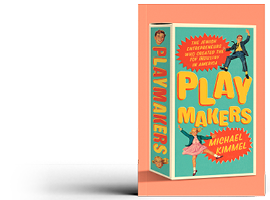
Playmakers
The Jewish Entrepreneurs Who Created the Toy Industry in America
Author – Michael Kimmel
Thursday, November 17 | 10:30 am
Cost: $10
Antisemites who deplore the extent to which Jews have insinuated their way into the national imagination have so far failed to scrutinize the savvy entrepreneurship of Jewish families in one industry: toys. In fact, there has only been minimal scholarship on Jews’ role in forming the material culture of childhood. This research gap has now been filled by sociologist Michael Kimmel’s fascinating book Playmakers. That Barbie is the staggeringly popular doll for which Ruth M. Handler was most responsible is widely known. That the teddy bear was an invention in the Brooklyn candy store of Rose and Morris Michtom may be only slightly less familiar. Far less known is that Kimmel is the Michtoms’ great-great-nephew. Kimmel intended to write a family history, to link his own memories and lineage to a toy corporation called Ideal. Instead, the author has branched out with a brilliant wider survey of all the major figures who designed, developed, packaged, and marketed dolls and dollhouses (mostly intended for girls); and subsequently the model fighter planes, destroyers, and “action figures” (mostly intended for boys). The teddy bear triumphed in the marketplace, Kimmel speculates, because this cuddly cub enjoyed a unisex appeal.
The immigrant families from which the playmakers sprang were usually too impoverished to provide the fun games and the children’s books that middle-class parents could give their own offspring. Deprivation and marginality injected an edge of longing and ambition, Kimmel writes, to endow millions of other children with the imaginary companions that the Lower East Side so conspicuously lacked over a century ago. Companies like Hasbro, Louis Marx, and the Lionel Trains of Joshua Lionel Cowan made the childhood of millions fuller and happier — and warranted nostalgia in which many of the entrepreneurs themselves could not partake.